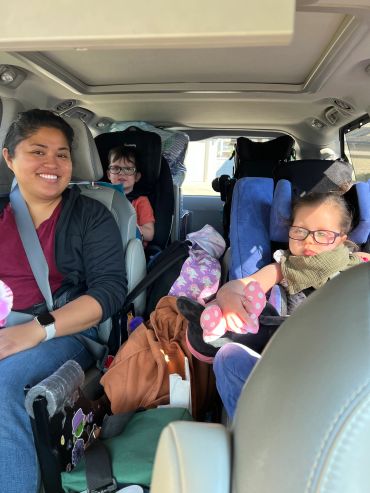
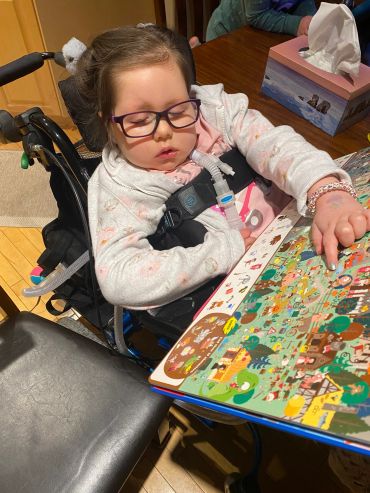
As a family, we continued to do everything we could to make memories together. We went for walks around our neighbourhood, attended community events, and took Willa anywhere we could manage with her wheelchair. It was during this time that we truly began to understand how inaccessible much of the world is for children with disabilities. Places designed for children, like playgrounds and parks, were often impossible for Willa to enjoy. Thankfully, we discovered an amazing accessible park that quickly became one of her favourite places. Seeing her smile there reminded us how important inclusion and accessibility truly are.
Medical appointments remained a constant part of our lives. Willa continued to undergo MRI scans every three months, and thankfully there was still no sign of cancer. She remained dependent on her ventilator, and we made the decision to focus on what mattered most: her rehabilitation, her education, and bringing as much joy and normalcy into her life as possible. Clinical trials and therapies were often exhausting for her. They would leave her completely drained, needing long periods of rest afterwards. We wanted her energy spent on being a little girl.
In 2021, I made the decision to move to self-managed care for Willa. This meant I could personally interview and choose the nurses who would be caring for her. Inviting someone into your home and trusting them with your child's life is one of the most difficult things a parent can do. I needed to know that every person on Willa's team genuinely cared for her and understood her needs.
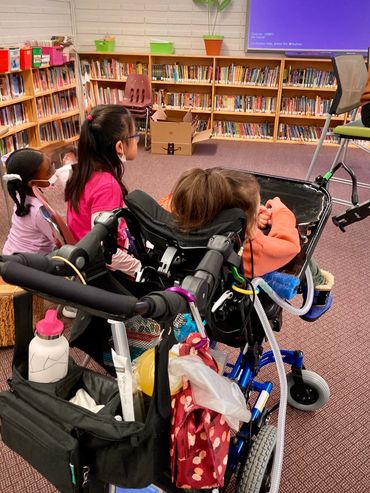
We were fortunate to already have an incredible RN and respiratory therapist who regularly supported us. Then we found Joyce. She became Willa's full-time day nurse, attending school with her and caring for her at home. From the moment Joyce entered our lives, it felt as though she was meant to be Willa's nurse. She understood her, advocated for her, and cared for her as if she were her own.
Building the right nursing team did not happen overnight. There were many nurses who came and went along the way, and I rarely left Willa's side, even when they were present. Trust was something that had to be earned. Over time, however, we found Willa's dream team—a group of nurses who became like family. They helped make it possible for Willa to attend school, participate in her community, and experience life beyond hospital walls. They gave us something we had not felt in a long time: confidence that she was safe and cared for.
As Willa grew, so did her need for specialized equipment. Throughout her journey, there were countless items that were essential to her quality of life but were not covered by government programs or private insurance. The costs quickly added up and created financial stress at a time when our focus needed to be on caring for Willa.
Thanks to the generosity of foundations, donors, and community support, we were able to access some of the equipment she needed. One of the most valuable pieces was a specially designed purple adaptive stroller. It became one of the most-used items we owned. It was much lighter than her wheelchair, making it easier to lift in and out of the vehicle, and it provided a smoother ride over sidewalks, trails, and uneven terrain. Most importantly, it gave us the freedom to get out into the community more often and enjoy family adventures together.
What might seem like a simple piece of equipment to most people made an enormous difference in Willa's life. It was another reminder that accessibility equipment is not a luxury—it is a necessity. Unfortunately, for many families, those necessities come with a price tag that can feel impossible to manage alone.

.jpg/:/cr=t:0%25,l:0%25,w:100%25,h:100%25/rs=w:370,h:493.3333333333333,cg:true)